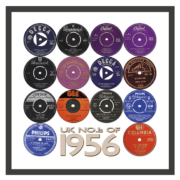



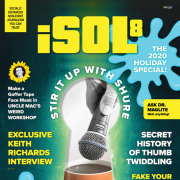
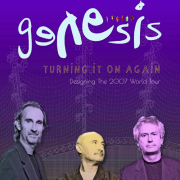
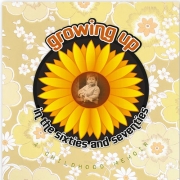

Most of the time, I write for a living but there are also occasions when I feel drawn to ‘the craft’ as a labour of love. A perfect example of this is a four-volume autobiography – my so-called ‘Growing Up’ chronicles – that I have written and designed over the past few years, exclusively for my children.
The complete set covers the years 1963 to 2016. Fully illustrated and printed in hardback format, each book is around 180 pages long, containing an average of 90,000 words. On the surface, this may seem a rather pompous exercise but I was thinking ahead.
In September 2015, an old school friend and I were chatting on the telephone about how much the world has changed in our lifetime. The conversation turned to my father who died in 1983. If he miraculously returned and visited some of the areas of east London in which he lived and worked, would he recognise them? Not likely. Could he possibly have foreseen the World Wide Web, e-mail, digital television and its zillion channels, social media and smartphones, and their effect on our daily lives? Absolutely not.
Thinking of the life that Dad led as a boy and a young man in the 1930s, ’40s and ’50s made me realise how wonderful it would have been if he – and indeed my mother – had written about those times, and kept stories as a resource to hand down to my sister and I, our own children and subsequent generations. As soon as these thoughts raced through my head, I voiced to my friend, “I don’t want my own children to wish the same. Even if they are not interested now, I feel sure that later on in life they would like to sit back and read about my times as a child and teenager because, after all, we are part of each other.”
After consulting some old diaries and a vast amount of photography and memorabilia that I could never bring myself to throw away, out came a long stream of consciousness that I typed out as recollections came to me. There were, of course, many references to music because songs are often like condensed diaries for me. The opening bar of a certain song can trigger a flood of images and scenes in my mind’s eye, and I found that the more I started to write, the more I remembered.
During this process, I discovered that I am a borderline hyperthymesiac. People with hyperthymesia have a superior autobiographical memory and are able to remember the events of any given calendar date, usually back to well before their teens, with stunning accuracy. They can compare similar dates and use their minds like databases, remembering odd details. I don’t fully qualify as one of the few people in the world to have such abilities, however, I remember enough about my very early childhood to fall within the spectrum. Fortunately, my father was a prolific photographer who, like myself, documented his children’s childhood with tireless regularity, and those old black and white snaps gained even greater value as I gave my memory a workout.
Time gives us context. It allows us to look back, unclouded. We can see the how and why, the when and where, and compare the now with then. With maturity and experience, we can reason with how we could have done things so much better but if life teaches us anything, it is that one only gains these assets by making mistakes – an art I continue to develop!
Few of us ever truly understand before opportunity expires that we must learn to live ‘in the moment’. When life is whipping up a cyclone, one has to find a way to slow down, look around and breathe. If you don’t, you will surely fall into the trap that Roger Waters described in his Pink Floyd song, ‘Time’: “And then one day you find / 10 years have got behind you / No one told you when to run / You missed the starting gun.”
Of course, living in the moment is difficult to achieve when you are writing about the past but, for me, that job is now done. The most exciting thing about life is never knowing what’s coming next.
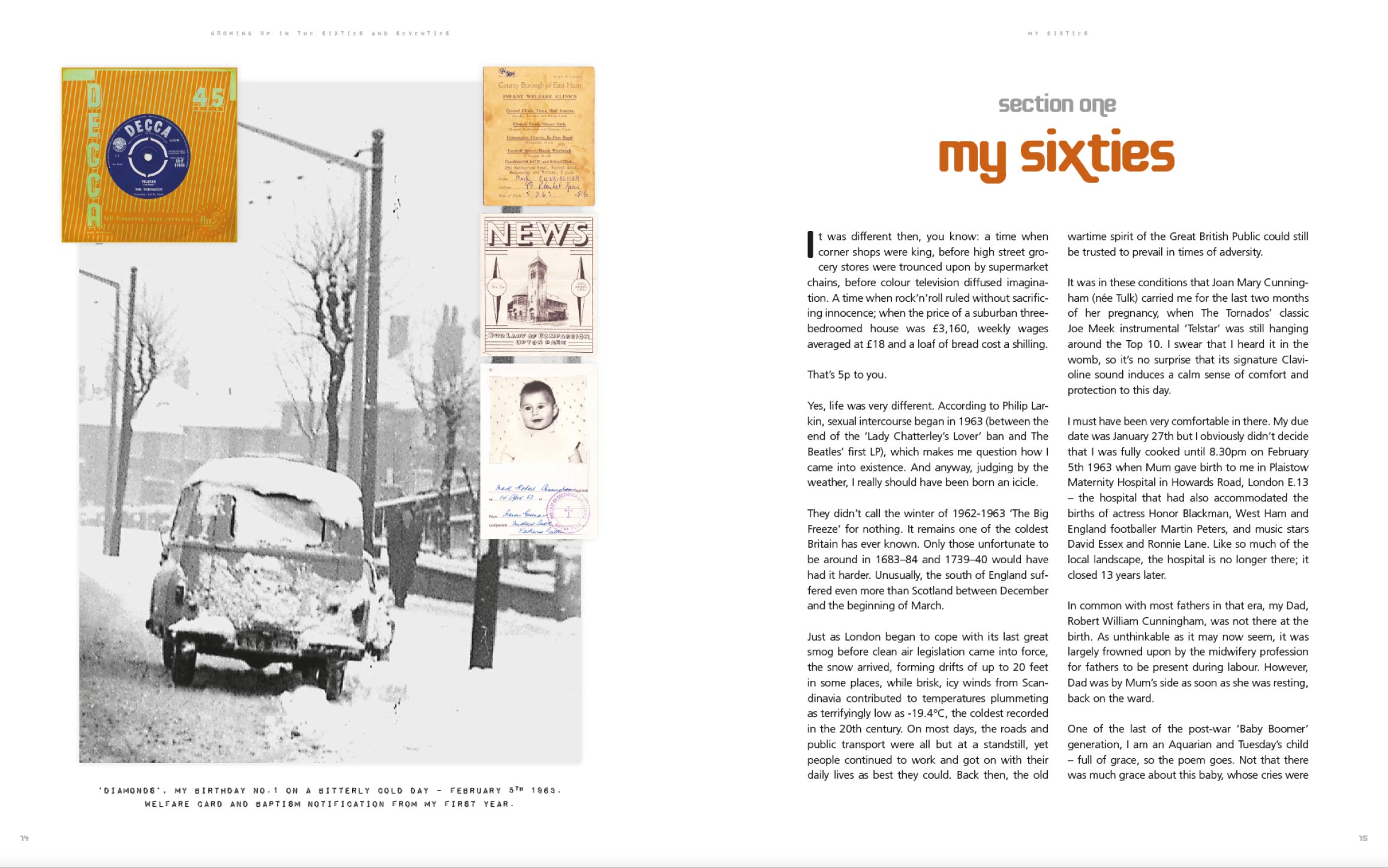
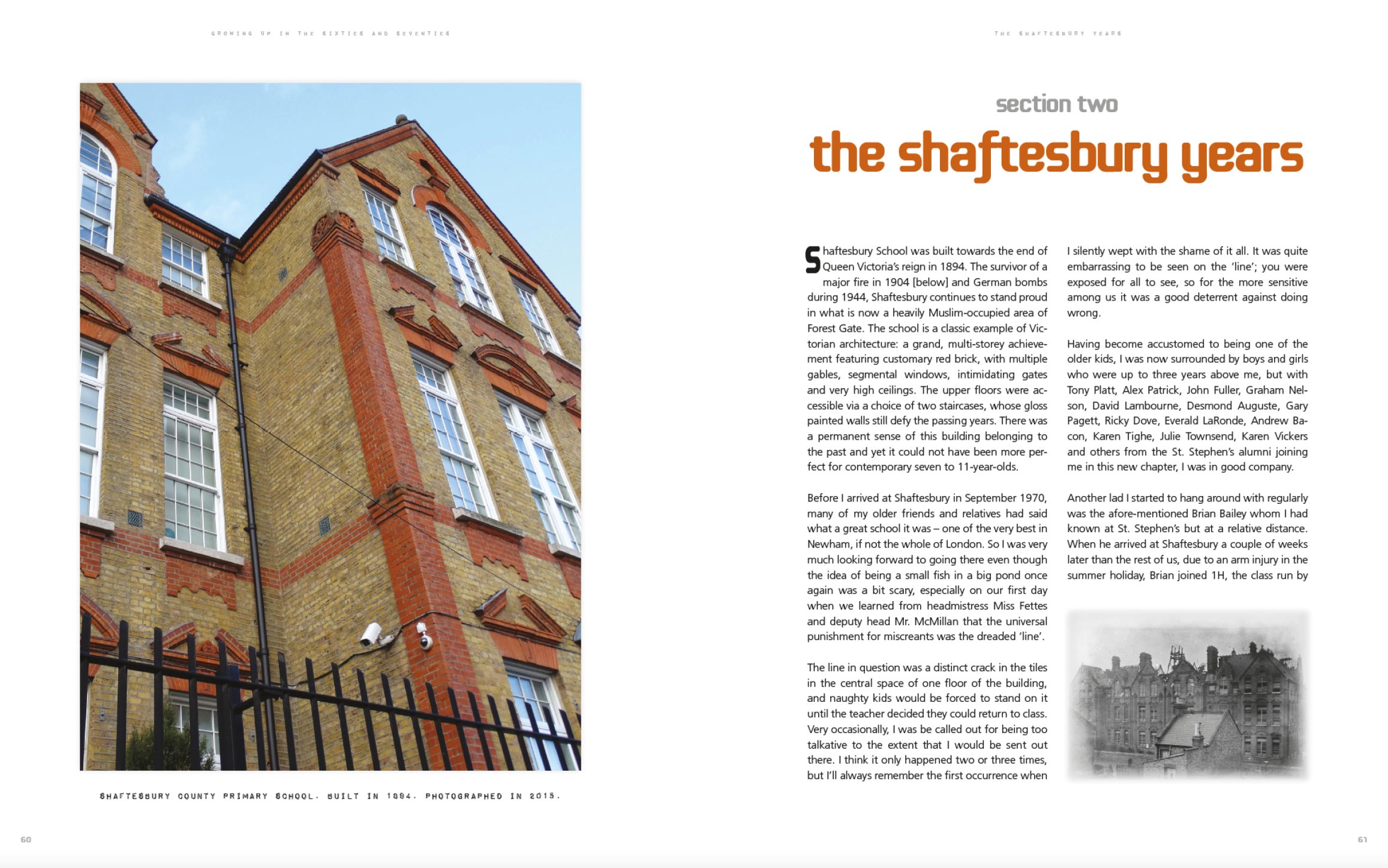
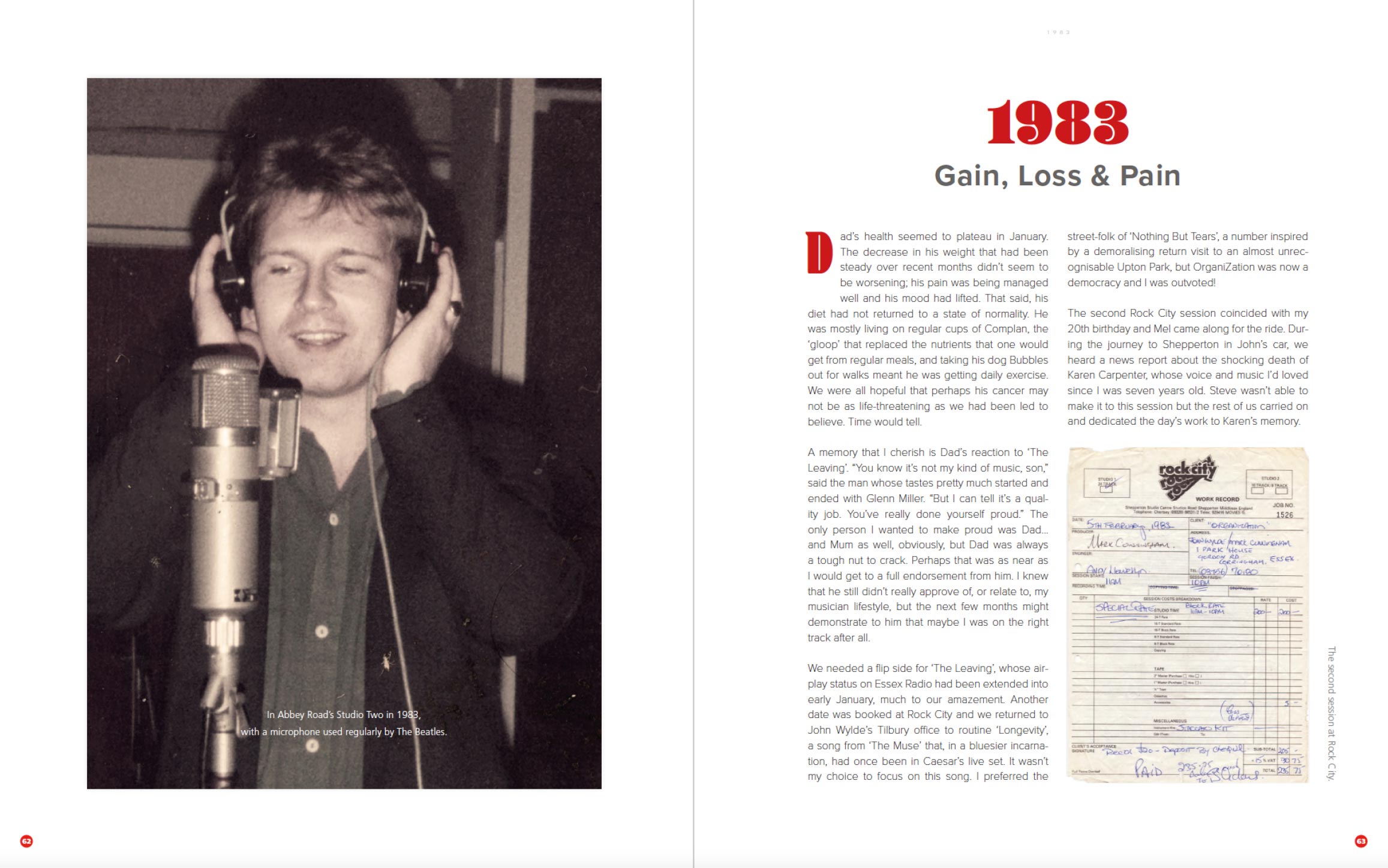
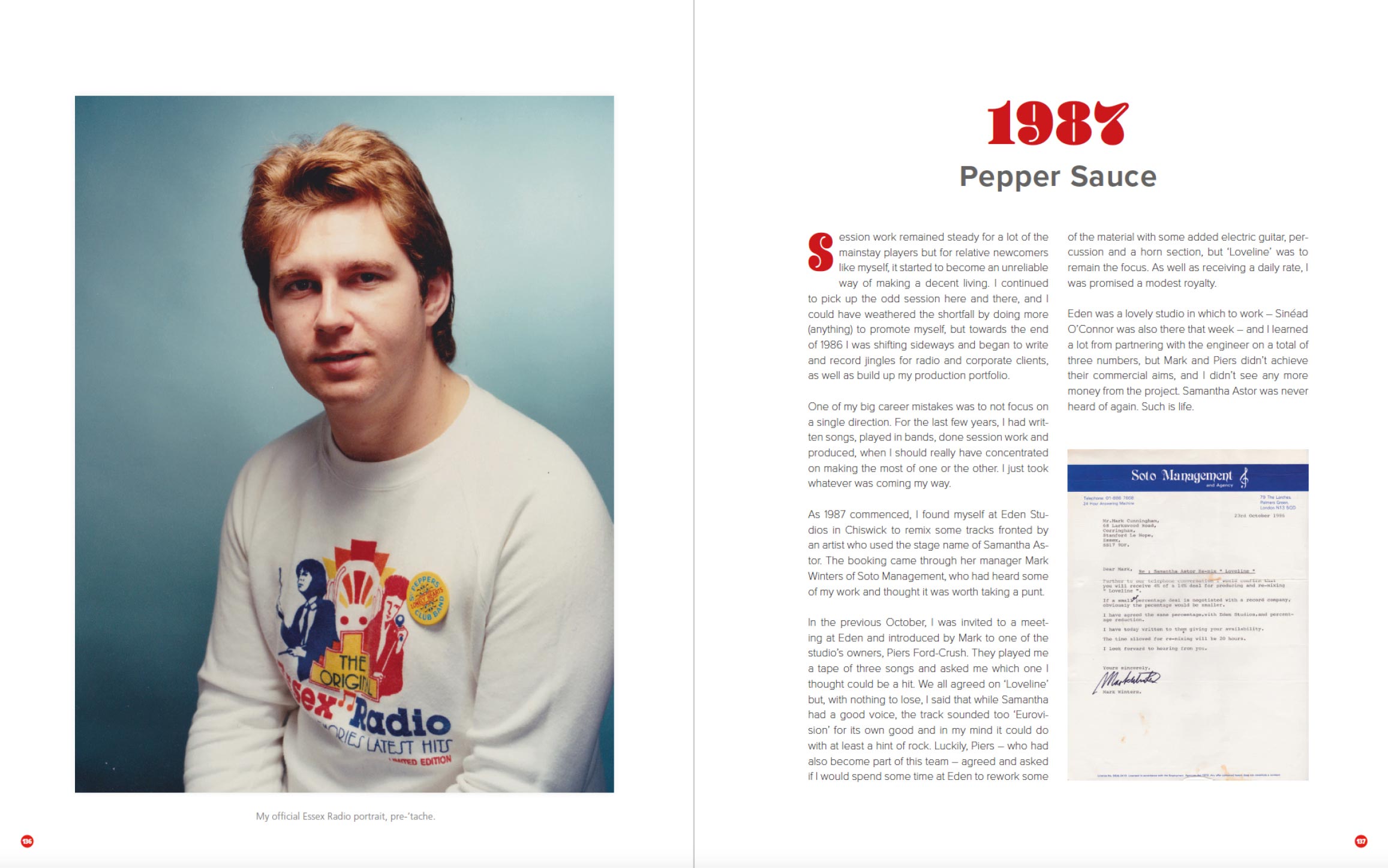
As I mentioned at the beginning of this article, the four books in this series were written exclusively for my children, which is why only five copies of each volume exist: one for each of my offspring, plus a reference copy for myself. Several people have urged me to make them publicly available but that’s completely missing the point. However, as well as the book spreads that appear below as random visual examples, I do intend to publish some illustrated extracts in this Blog section in due course (such as the Oasis at Knebworth story), and hope you find them amusing.
Mark Cunningham

By November ’95, (What’s The Story) Morning Glory had hit No.1 and was on the way to shifting over five million copies and scoring 14 platinum discs. The band followed the release with two fully subscribed nights at the 20,000-capacity Earls Court, a giant middle finger in the face of their nearest rivals Blur who, in the summer, had won a race to the top of the singles chart. In the space of a few months, the swanky Mancs had stolen their crown.
For a bunch of shoegazers, Oasis conveyed a rare energy. Their deafening levels of volume were such that the tube station opposite the exhibition centre was temporarily closed after low-frequency vibrations registered on the Richter scale. These Earls Court concerts really were the shape of things to come. ‘Wonderwall’ was the anthem of the day and Noel Gallagher told me after the first show’s soundcheck to expect bigger and better the following year. How right he was. Just one year after the gig I saw in Southend, Oasis had graduated to playing a pair of dates at Maine Road Stadium, the home of their beloved Manchester City F.C., setting the scene for what was arguably BritPop’s greatest moment: Knebworth.
This was hallowed ground. I had attended many stellar shows at Knebworth in the past, by bands such as the Floyd (my first outdoor gig experience in 1975), the Stones, Genesis, Zappa and Led Zeppelin, but when I checked into the Quality Clock Inn on the outskirts of Knebworth Park on August 9th, little prepared me for what was to come over the next two days and nights.
Drawing a record 250,000 fans, these two concerts defined the ’90s. They were the epicentre of the BritPop explosion and the summit of the Oasis legend, and I was so lucky to watch it all unfold. To give an indication of just how big the band were in 1996, nearly 5% of the UK’s population applied for tickets. The band could have sold out another 18 Knebworth shows.
The backstage excess was eye-watering and with 7,000 on the guest list, one might be forgiven for imagining that the band’s raison d’être was to piss all over the records set in the ’70s by history’s most outlandish rock stars. As fellow journalist Roy Wilkinson so accurately observed at the time, “An immense marquee was lined with bars, all fully stocked with any drink you could imagine. A barbecue sizzled eternal. To anyone with a pass, everything was free, day and night. There were also free ice creams and lollies, plus portrait artists and magicians permanently on call. Professional entertainers wandered the marquee offering tricks and caricature sketches.” The backstage party lasted through until the early hours each night. Of course, it would have been rude to not indulge but there was also a lot of work to be done.
The band’s choice of support acts was inspired. As well as the Manic Street Preachers, Cast, The Prodigy, Chemical Brothers and The Charlatans, the bill included The Bootleg Beatles – a smart move and a respectful nod to the band that motivated the elder Gallagher as a songwriter. Also starring were Kula Shaker, a band in their ascendency with the psychedelic summer anthem ‘Tattva’, a single that I rate amongst my absolute favourites of the decade, probably because it sounds like it was recorded in 1968.
I had pre-arranged an interview with them for one of my guitar magazine clients and, well, I can only describe it as hysterical. It didn’t start well on account of me referring to a completely different band’s single as “a genius début”. “Errrrr… we didn’t make that record,” said snooty frontman Crispian Mills, drily. It all went downhill from there, though it was not entirely my fault. I had studied an advance copy of the band’s first album, K, and been impressed by their modern take on psychedelia and especially their Indian music references. It was all very Syd-era Floyd, Walrus Fabs and flower power Quo poured through a Rishikesh filter, but done with an air of credibility.
The son of actress Hayley Mills and grandson of British film legend Sir John Mills, Kula Shaker’s leader wasn’t short of a few bob and his charmed life had given him an easier ride than most aspiring musicians. As we sat amongst his bandmates in a backstage portacabin and I asked him about the secrets of his songwriting, the patronising crap that flowed in response was astonishing.
“You’ve got to travel, man… I guess you wouldn’t know,” he said, referring to the five minutes he spent in India. This guy did not make it easy to like him.
Noel Gallagher was his polar opposite. On the second afternoon, I was welcomed into the Oasis camp to chat with him about the band’s touring achievements so far that year and he was brilliant. Basking in the spotlight of his inflated status, Noel wasted no time in grabbing the souvenir programme from my bag and collecting signatures on my behalf. “There you go, mate. That’ll be worth a fortune in years to come!” he said, every inch the wide boy.
At other times, I was grilling the crew about this vast production and gathering content for a wide range of features that spanned the trade and mainstream press in the UK, USA, Canada, Australia and Japan. Everyone wanted a story.
Knebworth was never as magnificent as this. After allowing myself to be jostled around in the crowd during the first night’s monumental communal experience, and singing myself hoarse during ‘Don’t Look Back In Anger’, I watched Sunday’s show from the top of the lighting tower and photographed the entire performance. One of those shots was licensed by the band themselves and by the PA system manufacturer Turbosound for a poster, as well as being reused by countless magazines.
My experiences with Oasis would continue all the way through to July 2009, when they played three nights at Wembley Stadium, just weeks before their split. Although tension was often in the air, it was only a year after Knebworth that I was faced with the most vivid example of the chaos for which the Gallaghers earned their reputation.
Music Bank’s rehearsal facility on the south side of London Bridge was one of my regular hangouts at the time. At one point or another, I oversaw rehearsals by the good, the bad and the ugly of BritPop, and nothing was quite as ugly as the time when the sibling rivalry between Noel and Liam Gallagher hit a peak just as Oasis were preparing for their Be Here Now tour – a tour now legendary for the cocaine-addled bad behaviour that occasionally ventured into The Who’s territory of old.
Liam and I crossed each other on a staircase. “You here to do all that the knobs and faders malarkey again, mate?” he asked. How astute.
About half an hour after interviewing Noel with sound engineer Huw Richards and lighting designer Mikey Howard for SPL, the new magazine I had founded for SOS Publications, I was having a quiet cuppa in the production office when I could hear an argument drawing nearer and nearer, until Liam barged through the door, picked up a nearby computer and threw it on the floor with great force, smashing it to smithereens. Bejaysus!
The singer stood there for a few seconds, surveying his work, before Noel came barging in after him. “What have you fookin’ done?” Noel yelled, twatting ‘Our Kid’ with a tasty right hook and then making a swift exit, muttering “stupid fookin’ c**t” under his breath. The show was over. Nothing more to see here.
Being around the Gallaghers was never dull and neither was this job.
Adapted from ‘Heartsongs: My Family And Career in the Nineties’ by Mark Cunningham
Fifty ye ars ago, on November 15th 1969, BBC1 and ITV simultaneously launched a regular colour television service in the UK.
Although BBC2 had been mostly broadcasting in colour for two years, this was the big roll out. While ‘An Evening With Petula’, featuring a Petula Clark concert from the Royal Albert Hall, became the first colour programme shown on BBC One, the less glamorous ‘Royal Auto Club Road Report’ was ITV’s colour début.
Despite the hype, the high cost of colour TV sets and the limited range of transmission across Britain meant that few people were able to enjoy this revolution at first. The average cost of a colour set, £300, prompted most people to rent. It wasn’t until 1976 that colour became more commonplace than black and white.
The thing about monochrome was that it didn’t represent real life. This became apparent when my Dad took me to see my first football match – West Ham United vs. Coventry City – in late September 1968. Played at the Boleyn Ground, just a few minutes’ walk from my home, it was a fairly inconsequential 0-0 draw but for me it was an extraordinary experience. As we trudged up the steps to the West Stand, the pitch gradually opened up before my eyes. Under the evening floodlights, it was the richest, most vivid green this boy’s eyes had ever seen, and when the Hammers walked out in their claret and blue, it was a mind-blowing explosion of colour. It was as if life itself was erupting in front of me.
At the end of 1969, when only 200,000 colour sets were in circulation in the UK, the only person I knew who owned one was my Auntie Kate. I remember sitting, bug-eyed, in front of her TV on New Year’s Eve, thinking this was some kind of a miracle. My Dad showed great restraint. I was still watching black and white TV at home until the autumn of 1972 when, finally, I could watch ’Top Of The Pops’ in all its glam glory. Let’s face it: ‘Crazy Horses’ would’ve been rubbish in monochrome.
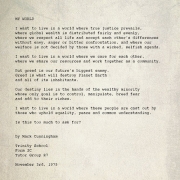
 Standing at the counter in the East Ham branch of WH Smith, I spotted a flyer announcing a writing competition, entitled ‘Change The World’. I had only popped in there to buy the new Elton single (‘Island Girl’) but here was an opportunity – one that might win me a £15 book token if I was good enough. It turned out that I was.
These were the thoughts of young Master Cunningham. The books I ended up buying with my prize included Frederick Forsyth’s ‘The Odessa File’ and ‘The Ascent of Man’ by Jacob Bronowski. Pretty deep for a lad of 12 (and nine months).
Sure, the piece I wrote was naïve, but I still stand by every word. Greed is, indeed, this planet’s biggest enemy and, yes, I do want to live in a world where true justice prevails. You may say I was a dreamer, but I wasn’t the only one. After all, John Lennon was climbing the chart with ‘Imagine’ and he could say it better than I ever could.